


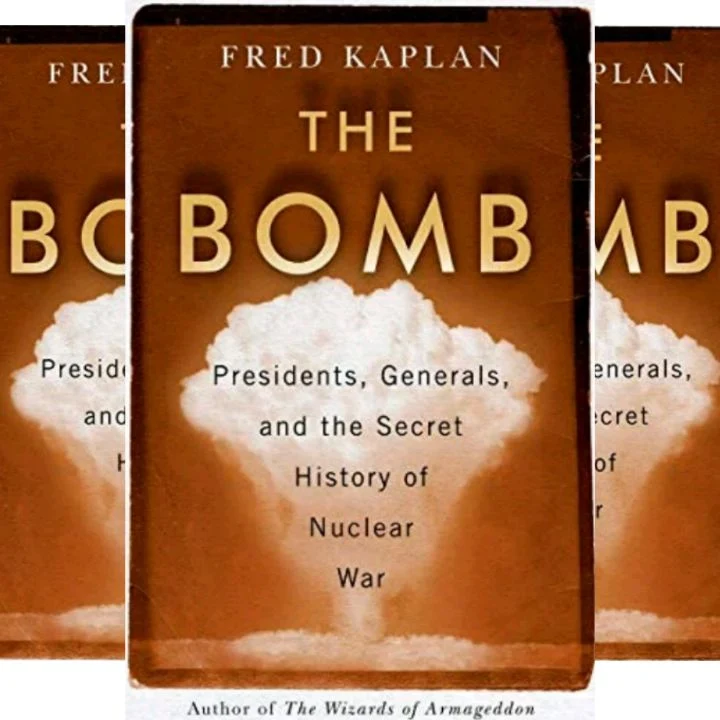
Book Overview - The Bomb: Presidents, Generals, and the Secret History of Nuclear War
"The Bomb" book by Fred M. Kaplan (author) is a detailed historical account of how American presidents, senior military commanders, and government officials have developed, managed, and debated the use of nuclear weapons since the end of the Second World War.
Rather than focusing solely on the scientific development of the atomic bomb or the physical destruction it can cause, Kaplan examines the political decisions, military strategies, personal rivalries, and ethical dilemmas surrounding nuclear warfare.
The author explores how successive US administrations have attempted to use nuclear weapons as instruments of deterrence; threatening devastating retaliation to prevent an enemy from attacking while also trying to avoid the catastrophe that actual nuclear war could bring.
Drawing on interviews, historical archives, and previously classified documents, Kaplan takes readers into the decision-making environments of the White House, the Pentagon, and American strategic military commands. His central concern is the difficult relationship between the power to wage nuclear war and the responsibility to prevent one.
The book is particularly significant because it reveals that nuclear policy is not simply a matter of weapons and military capability. It is also shaped by human judgment, institutional interests, political calculations, and the uncertainty of how an adversary might respond to a nuclear threat.
One of the book’s most important themes is nuclear deterrence. This is the belief that a country can prevent an enemy from attacking by maintaining the ability to inflict unacceptable destruction in retaliation.
During the Cold War, the United States and the Soviet Union developed enormous nuclear arsenals. Each side understood that a nuclear attack could provoke retaliation so devastating that neither country could reasonably expect to escape the consequences.
Kaplan explores the paradox at the heart of this strategy: leaders must convince their opponents that they are prepared to use nuclear weapons, even though using them could destroy millions of lives and undermine the very security they seek to protect.
The book questions whether this strategy is genuinely rational or whether it depends on threats that no responsible leader should ever want to carry out.
Furthermore, the book raises a fundamental question about democratic government: How much control does a president truly exercise over the military machinery designed to wage nuclear war?
Kaplan's historical account suggests that presidential authority does not always translate into complete control over the plans, institutions, and assumptions that shape nuclear policy.
The author also examines the development of doctrines such as mutually assured destruction, under which both sides possess the ability to devastate each other even after suffering a nuclear attack.
Kaplan explains how military planners attempted to develop more flexible options, including targeting military installations rather than cities. Yet these alternatives raised difficult questions: could a nuclear exchange really remain limited, or would one attack trigger a wider and uncontrollable conflict?
Another major theme of the book is whether a nuclear war could be fought on a limited scale without escalating into a full-scale catastrophe.
Military strategists have repeatedly explored ways to use nuclear weapons against selected targets while avoiding a broader exchange. The objective would be to achieve a military or political goal without triggering total nuclear war.
Kaplan examines the contradictions within this approach. An opponent might interpret even a limited nuclear strike as the beginning of a much larger attack and retaliate accordingly. Once nuclear weapons are used, leaders may struggle to predict the enemy's response or control subsequent escalation.
The book consequently challenges the assumption that nuclear conflict can be managed like a conventional military operation. It points to the fact that the distinction between a limited nuclear exchange and an all-out nuclear war may be far less reliable than strategic planners would like to believe.
Kaplan further examines efforts to reduce nuclear stockpiles and limit the danger of nuclear confrontation. Arms control involves negotiating restrictions on weapons, deployments, testing, or military activities. Disarmament goes further by seeking reductions in, or the eventual elimination of, nuclear weapons.
The book shows that progress in these areas depends on more than presidential declarations. Leaders must overcome institutional resistance, strategic mistrust, domestic political pressures, and the belief that retaining large arsenals is necessary for national security.
Fred M. Kaplan's Central Message
The central message of "The Bomb" book is that nuclear weapons create a profound contradiction in international politics: governments maintain the threat of extraordinary destruction in the hope of preventing war, yet the policies intended to provide security can also create the conditions for catastrophe.
Kaplan does not present nuclear strategy as a straightforward technical problem with a clear solution. Instead, he reveals how nuclear planning is filled with uncertainty, competing interests, questionable assumptions, and difficult moral choices.
Key Observations
While the book is informative and insightful, readers should keep a few things in mind:
• Its primary focus is US nuclear policy. Readers seeking an equally detailed account of Soviet or Russian, Chinese, Indian, Pakistani, or other nuclear doctrines will need additional sources.
• The historical detail and discussions of military strategy can be challenging for readers unfamiliar with international relations or nuclear policy.
• Kaplan gives considerable attention to the struggle between civilian leaders seeking restraint and military institutions defending established strategic practices. Readers may wish to compare his interpretation with other historians and security analysts.
These observations do not diminish the book's value; they help clarify its scope. It is principally a history of American nuclear decision-making.
Who Should Read this Book?
"The Bomb" is particularly suitable for:
• Students and researchers studying international relations, political science, history, and security studies.
• Military officers, defence professionals, and policymakers interested in strategic planning and civilian control of armed forces.
• Readers interested in the Cold War, American foreign policy, and presidential decision-making.
• Anyone seeking to understand nuclear deterrence, arms control, disarmament, and the risk of escalation.
• General readers who want to understand how governments manage weapons capable of causing destruction on an unprecedented scale.
• It is especially useful for readers who want to go beyond the basic history of the atomic bomb and understand how nuclear weapons continue to influence diplomacy, military planning, and international security.
Summary
The book is both a historical study and a warning about the consequences of relying on threats of catastrophic violence to preserve peace. Its most important lesson is that preventing nuclear war requires more than possessing the ability to retaliate; it requires sound judgment, effective political oversight, credible diplomacy, and a sustained commitment to reducing the risk of catastrophe.
Book Details
- Title: The Bomb: Presidents, Generals, and the Secret History of Nuclear War
- Author: Fred M. Kaplan — A national-security columnist. He authored ‘The Wizards of Armageddon’ and other several books on military strategy.
- Publisher: Simon & Schuster
- Format: eBook / Hardcover / Paperback
- Type: War History / Nuclear Weapons / Military Strategy / International Relations
- Publishing Date: 28/January/2020
- Print length: 378 Pages...


Share Your Thoughts